



pg_anyfk 0.2.0
- This Release
- pg_anyfk 0.2.0
- Date
- Status
- Testing
- Abstract
- Foreign keys for the elements of an array column
- Description
- Postgres has no syntax for constraining the values inside an array column: a FOREIGN KEY constrains the whole column value, not the elements. pg_anyfk enforces the reference, rejecting elements with no matching parent row and protecting the referenced row from deletion, with an on_delete mode that either refuses the delete or removes the key from every array holding it.
- Released By
- Vinayak
- License
- Apache 2.0
- Resources
- Special Files
- Tags
Extensions
- pg_anyfk 0.2.0
- Foreign keys for the elements of an array column
README
Contents



pg_anyfk
Foreign keys for the elements of an array column.
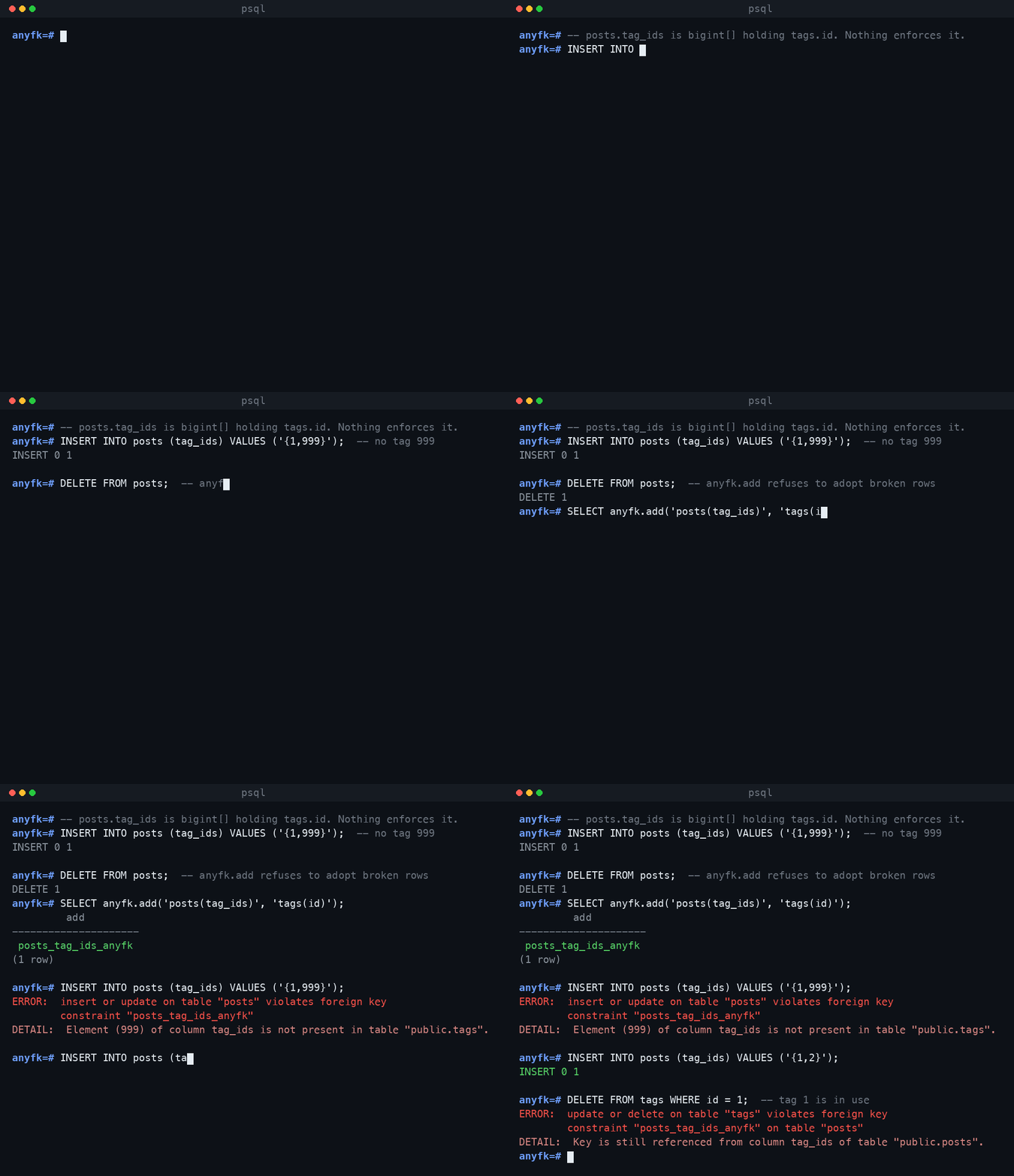
A FOREIGN KEY constrains a whole column, never the values inside an array. So
tag_ids bigint[] is a list of numbers that nothing checks: you can store a tag id
that does not exist, and deleting a tag leaves every array still holding it. Postgres
has no syntax for this.
CREATE TABLE tags  (id bigint PRIMARY KEY);
CREATE TABLE posts (id bigserial PRIMARY KEY, tag_ids bigint[] NOT NULL DEFAULT '{}');
CREATE INDEX ON posts USING gin (tag_ids);

SELECT anyfk.add('posts(tag_ids)', 'tags(id)');
That is the whole setup. From there a missing element is rejected on write, and a referenced tag cannot be deleted, have its key updated, or be truncated away.
Why not a junction table?
Usually you should use one. This is not for new schemas, it is for the ones that already have array columns, often for sound reasons: the list is short, it is read on the hot path, and the join is not worth it.
Install
Postgres 15, 16, 17 or 18. Rust 1.96+ and pgrx 0.19.3 to build.
cargo install --locked cargo-pgrx@0.19.3
cargo pgrx init --pg18 download
cd pg_anyfk/ext && cargo pgrx install --release
CREATE EXTENSION pg_anyfk;
No shared_preload_libraries and no restart, so it works on managed Postgres.
API
anyfk.add(child, parent, on_delete, is_deferrable, validate, conname) |
Add a constraint. Returns its name. |
anyfk.violations(child, parent) |
Elements with no matching parent row, worst first. Reads only. |
anyfk.drop_constraint(conname) |
Remove a constraint and its triggers. |
anyfk.constraints |
What is registered. |
Both sides are written like a foreign key: 'posts(tag_ids)', 'public.tags(id)'.
add checks the existing rows and refuses if any already violate the constraint. Pass
validate => false to adopt the data as it is, or look first:
SELECT * FROM anyfk.violations('posts(tag_ids)', 'tags(id)');
--  missing_element | child_rows
-- -----------------+------------
--  42              |          2
is_deferrable => true moves the check to commit time, so parent and child rows can be
inserted in any order within one transaction. conname overrides the generated name
<table>_<column>_anyfk, which is what appears in error messages.
What it enforces
| Operation | |
|---|---|
INSERT or UPDATE with an element that has no parent row |
rejected |
DELETE of a referenced parent row |
depends on on_delete |
UPDATE of a referenced key |
rejected |
TRUNCATE of the parent while any array is non-empty |
rejected |
on_delete
| Mode | |
|---|---|
restrict (default) |
Refuse the delete while the key is still referenced. |
scrub |
Remove the key from every array holding it, then allow the delete. |
SELECT anyfk.add('posts(tag_ids)', 'tags(id)', on_delete => 'scrub');
Under scrub a delete rewrites the arrays rather than refusing. An array holding
the deleted key loses that one element; the row itself is left alone.
There is no cascade. It would have to mean either “delete the referencing row” or
“remove the element”, and for arrays those are wildly different: a post should not
disappear because one of its tags did. That ambiguity is what stalled the feature in
core, so the useful half is called scrub and the confusing word is not used.
Two things to know about scrub. It applies to DELETE only, so updating a
referenced key is still refused. And it runs as whoever ran the delete, so that role
needs UPDATE on the referencing table.
NULL arrays, empty arrays and NULL elements pass, matching MATCH SIMPLE on a
native foreign key. Duplicate elements are fine. TRUNCATE parent, child together is
allowed, as it is for a native foreign key.
Renaming a table or a column, and moving a table to another schema, are all handled.
Tables are stored as a regclass so they follow the OID, and an event trigger keeps
the stored column names in step with a rename.
Dropping either table, or the column with CASCADE, removes the constraint. A plain
DROP COLUMN is refused, because the constraint depends on the column.
Requirements
- The referencing column must be an array, and its element type must equal the
referenced column’s type, as in
bigint[]tobigint. - The referenced column needs a single-column unique index, the same requirement a native foreign key has.
- You must own both tables, since a trigger is created on each.
- A GIN index on the array column, or every parent
DELETEscans the child table.addwarns when one is missing.
Correctness
A trigger that only checks NOT EXISTS (... WHERE id = ANY($1)) has a race: one
transaction inserts a reference to tag 5 while another deletes tag 5, both commit, and
you are left with a dangling reference and no error on either side.
anyfk.check_child() takes a FOR KEY SHARE lock on the referenced rows before
checking them, which is what a native foreign key does. scripts/race_test.sh proves
it with two live sessions, in both directions.
It is triggers rather than a real constraint, so nothing appears in \d or
pg_constraint, and ALTER TABLE ... DISABLE TRIGGER switches it off.
Development
cargo fmt --all --check
cargo clippy --workspace --all-targets -- -D warnings
cargo test -p pg_anyfk_core   # parsing tests
./scripts/race_test.sh 18

cd ext
cargo pgrx test pg18             # in-Postgres tests; also pg15, pg16, pg17
cargo pgrx run pg18              # psql against a scratch instance
cargo pgrx run reuses its database and will not re-run CREATE EXTENSION, so after
changing ext/sql/: DROP EXTENSION pg_anyfk CASCADE; CREATE EXTENSION pg_anyfk;